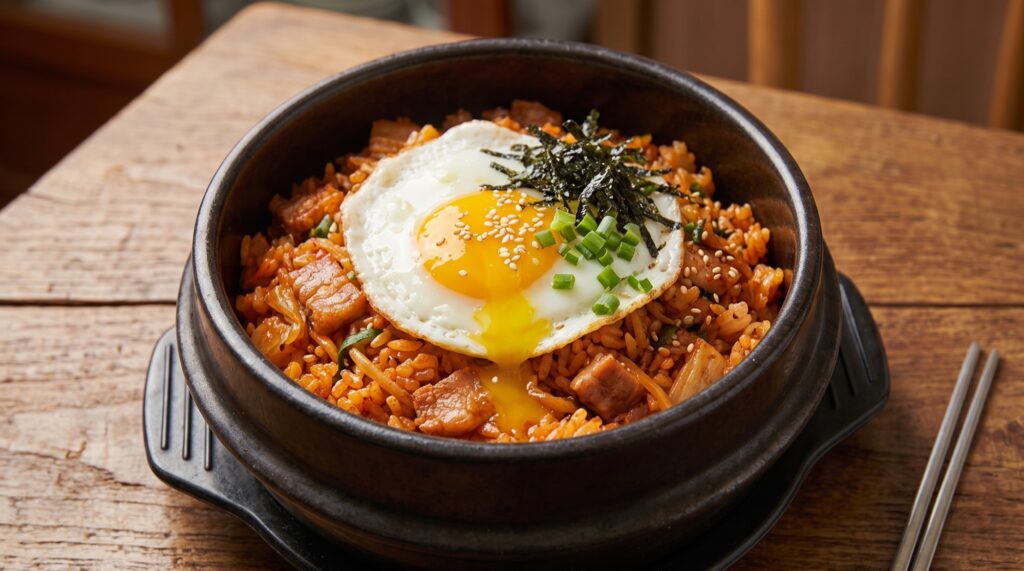
Every Korean household has a jar of kimchi in the back of the fridge that has gone too far — too sour to eat straight, too much of it to throw out. Kimchi fried rice exists for exactly that jar. It is the dish Korean parents make on a Sunday night when nobody wants to think about dinner, and it is genuinely better with old kimchi than with fresh.
Fifteen minutes, one pan, and everything you need is at Kroger or Trader Joe’s.
Where This Dish Comes From
To really appreciate kimchi bokkeumbap, it helps to understand the Korean relationship with bap — rice — and the art of using up leftovers. Korean meals are built around a bowl of freshly steamed rice with banchan alongside, and because rice is cooked daily, home cooks are constantly reinventing yesterday’s batch.
Pairing that leftover rice with well-aged kimchi and a little fat was a small stroke of genius. It turns aging pantry staples into a fast, deeply flavored skillet meal. Today it is a staple of university dorms, late-night convenience stores, and busy households across Korea.
The One Rule: Your Kimchi Should Be Sour
This is the part most English-language recipes skip, and it is the whole dish. Fresh kimchi is crunchy and mild. Cooked, it tastes like warm cabbage — thin, a little sweet, forgettable. Kimchi that has fermented for a month or more has developed lactic acid, and that acid is what gives the finished rice its depth.
If your kimchi is still new, leave the jar on the counter at room temperature for one to two days. It will bubble and smell sharper. That is what you want. Push it back in the fridge and use it the next day.
What is actually happening is fermentation. As kimchi ages, lactic acid bacteria break down the sugars in the vegetables and produce acid. That acid is the backbone of the finished dish — it cuts the fat, deepens the savoriness, and gives the rice its characteristic tang. Fresh, sweet kimchi has not made any of it yet.
If the kimchi tastes good raw, it is too young for fried rice. Save it for a side dish.
K-Food 4 U kitchen note
What You Need
Serves 2 as a full meal.
- 2 cups cooked short-grain rice, cold from the fridge (day-old is ideal)
- 1 1/2 cups sour napa cabbage kimchi, chopped into bite-size pieces
- 3 tbsp kimchi juice from the jar — do not skip this, it carries most of the flavor
- 4 oz pork belly, bacon, or Spam, diced small (or leave it out entirely)
- 1 tbsp gochujang (Korean chili paste) or 1 tsp gochugaru for a cleaner heat
- 1 tsp toasted sesame oil, added at the very end
- 1 tbsp neutral oil for the pan, plus 1 tbsp butter
- 2 eggs, for frying
- 2 scallions and toasted sesame seeds to finish
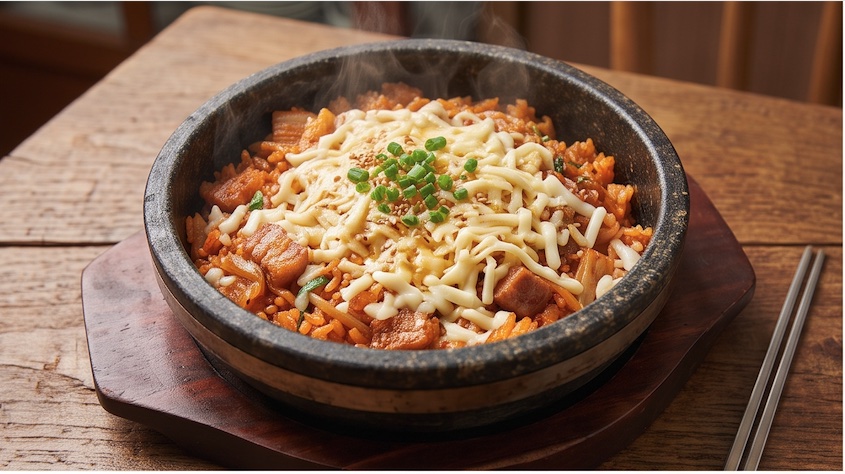
Optional but very good: a handful of shredded mozzarella melted over the top in the last minute. This is not traditional, but it is what half of Seoul actually does.
How to Make It
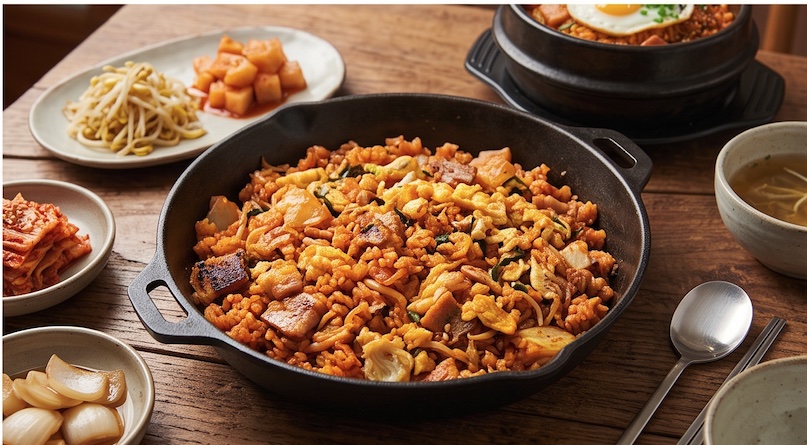
- Heat the neutral oil in a large skillet over medium-high. Add the pork belly or bacon and cook until the fat renders and the edges crisp, about 4 minutes. If you are skipping the meat, go straight to step 2.
- Add the chopped kimchi and cook for 4 to 5 minutes without stirring much. You want it to sizzle and darken, not steam. This step is where the flavor is built — do not rush it.
- Stir in the gochujang and the kimchi juice. Cook for 1 minute until it looks glossy and slightly reduced.
- Add the cold rice and the butter. Break the rice apart with the back of your spatula and press it into the pan. Let it sit for 30 seconds at a time between stirs so the bottom gets a little crust.
- Turn off the heat. Drizzle in the sesame oil and toss once. Taste — if it is flat, it needs more kimchi juice, not more salt.
- Fry the eggs in a separate pan, sunny side up with a crisp edge. Slide one over each bowl of rice, scatter the scallions and sesame seeds, and eat immediately.
The Details That Actually Matter
- Cold rice, always. Fresh rice is full of steam and turns to paste in the pan. If you only have hot rice, spread it on a sheet pan and refrigerate for 20 minutes.
- Short-grain, not jasmine or basmati. Look for Kokuho Rose, Nishiki, or Calrose — all three are in the rice aisle at most large US supermarkets. Long-grain rice will not hold the sauce.
- Do not crowd the pan. Cooking for four? Do two batches. A crowded pan steams the kimchi instead of frying it, and you lose the char entirely.
- Butter is not a shortcut. The dairy fat rounds off the sourness of the kimchi. Korean home cooks have done this for decades.
- Season at the end, if at all. Kimchi, gochujang, and bacon are all salty already.
The cold rice rule has a reason behind it. When cooked rice cools — especially overnight in the refrigerator — its starch molecules recrystallize in a process called retrogradation. The grains firm up and lose their surface stickiness, which lets each one coat in hot seasoned oil and sear instead of steam. Warm rice is full of moisture, and moisture is what turns fried rice into paste.
Where to Buy the Two Korean Ingredients
| Ingredient | Where to find it | What to look for |
|---|---|---|
| Napa cabbage kimchi | Refrigerated section near tofu; Costco, Trader Joe’s, most Krogers | Jongga or Tobagi. Check that cabbage is the first ingredient. |
| Gochujang | International aisle, or Trader Joe’s own brand | A red tub or squeeze bottle. Sunchang and CJ Haechandle are standard. |
| Gochugaru | International aisle or online | Coarse flakes, not fine powder. Not the same as cayenne. |
| Short-grain rice | Rice aisle | Kokuho Rose, Nishiki, or Calrose |
Make It Yours
- Tuna kimchi fried rice — a drained can of tuna instead of pork. This is a Korean student staple and takes ten minutes.
- Spam — divisive elsewhere, completely normal in Korea. Dice it small and let it crisp.
- Vegetarian — skip the meat, add sliced shiitake mushrooms in step 1 and a splash of soy sauce. Check your kimchi label for fish sauce or salted shrimp if that matters to you.
- Cheese — mozzarella over the top, lid on, one minute off the heat.
Common Questions
Can I use kimchi from a jar that has been open for months?
Yes — that is the ideal kimchi for this dish. As long as it smells sour and tangy rather than genuinely rotten, and there is no fuzzy mold on the surface, it is fine. Kimchi is a preserved food and keeps for a long time in the refrigerator.
How spicy is it?
Milder than most people expect. The heat comes from the kimchi and the gochujang, both of which are more savory than hot. To dial it down further, use 1 tsp of gochujang instead of a tablespoon and add an extra pat of butter. The fried egg on top also softens everything.
Do I have to add the egg?
No, but the runny yolk works as a sauce when you break it into the rice. If you skip it, add a little more sesame oil to compensate.
How long does it keep?
Three days in the refrigerator. Reheat in a skillet rather than a microwave — you get the crisp bottom back. Do not freeze it; the rice texture falls apart.
Made it? The next thing to cook with that same jar of kimchi is kimchi jjigae, the stew version. Same principle, same sour kimchi, twenty more minutes.