If you have cooked with Japanese miso and assumed doenjang is the Korean version of it, this guide is going to be mildly annoying. They are cousins, not twins. Substitute one for the other and the dish will not be a slightly different version of itself — it will be a different dish, usually a disappointing one.
Here is what doenjang actually is, why it tastes the way it does, and what to do with the tub once it is in your fridge.
It Comes Out of the Same Pot as Soy Sauce
Doenjang is not made alongside Korean soy sauce. It is made in the same batch, and this is the single most useful fact about it.
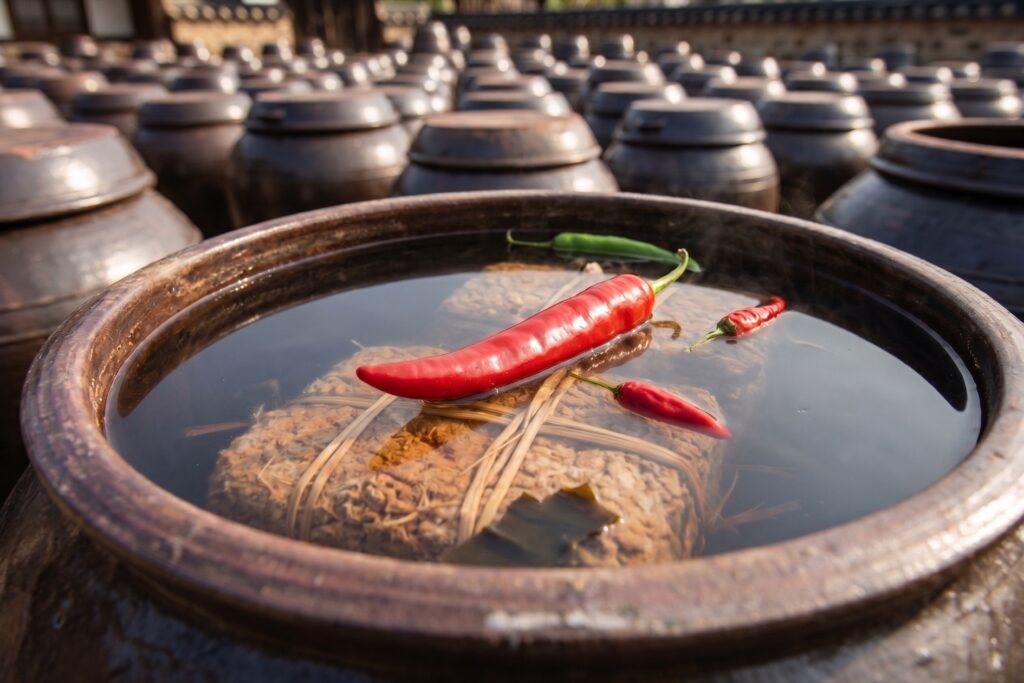
Soybeans are boiled, crushed, pressed into blocks called meju, and hung to dry while wild molds colonize them. The meju blocks go into a crock of brine for months. At the end, the liquid is drained off and becomes ganjang — soy sauce. The solids left behind in the crock are mashed, salted again, and aged further. Those become doenjang.
One crock, one fermentation, two products. Korean soy sauce and Korean soybean paste are siblings, not neighbors.
K-Food 4 U
The full story of that crock — and why it is culturally enormous in Korea — is in Part 1 of our soy sauce guide.
Doenjang vs Miso: The Actual Difference
The difference is not a matter of degree. It is a difference in what goes into the ferment.
| Doenjang (된장) | Miso (味噌) | |
|---|---|---|
| Grain koji | Traditionally none | Rice or barley koji, a large proportion |
| What ferments it | Wild molds and bacteria on the meju | Cultivated koji mold, inoculated |
| Texture | Coarse, chunky, whole bean pieces | Smooth, uniform paste |
| Salt | Higher | Lower, varies widely by type |
| Flavor | Sharp, funky, deeply savory | Rounder, sweeter, milder |
| Made with soy sauce? | Yes — same batch | No, separate product |
That grain koji row explains almost everything downstream. Rice or barley brings starch, starch ferments into sugar, and sugar is why miso tastes gentle and slightly sweet. Traditional doenjang has no grain in it at all — just soybeans and salt, worked on by whatever molds happened to land on the meju. The result is stronger, saltier, and rougher around the edges, with a funk that people either love immediately or need a few meals to come around to.
So: miso soup and doenjang-jjigae are not the same dish in two languages. Miso soup is delicate and served alongside a meal. Doenjang-jjigae is a bubbling, assertive, salty stew that is often the center of the table.
Traditional vs Modern Doenjang
Most doenjang sold in a tub today is not made the meju-in-a-crock way, and the labels distinguish them.
| Label | What it is |
|---|---|
| 재래식 된장 — jaeraesik doenjang | Traditional. Meju, brine, time. Saltier and funkier. |
| 개량 된장 — gaeryang doenjang | Modernized. Uses cultivated koji, often with wheat or rice. Milder, more consistent. |
| No marking | Usually the modernized style. Read the ingredients. |
Neither is a fake. The modernized style ferments faster, tastes milder, and is what most Korean households actually buy — the same situation as blended soy sauce. But if you have tried doenjang and found it underwhelming, there is a reasonable chance you had a mild industrial one, and a traditional tub would change your mind.
What You Actually Cook With It
Doenjang-jjigae
The stew. Doenjang, water or anchovy stock, tofu, zucchini, onion, chili, and whatever protein is around. It is the weeknight default in a Korean home the way a pot of soup is elsewhere. Start with about one tablespoon of doenjang per cup of liquid and adjust — brands vary enormously in saltiness.
Doenjang-guk
The thinner soup version, usually with a leafy green like spinach or napa cabbage. Less doenjang, more liquid, no chili paste. This is the closest doenjang gets to miso soup, and it is still a good deal saltier.
Seasoning vegetables
Blanched greens — spinach, chard, radish greens — are often dressed with doenjang rather than salt or soy sauce. A small spoonful, sesame oil, garlic, sesame seeds. It gives the vegetable a savory backbone that plain salt cannot.
Taking the edge off meat and fish
A spoonful of doenjang in the water when boiling pork, or rubbed on fish before cooking, is a standard Korean move for cutting gaminess. It is doing the same job as ginger, by different means.
Buying It in the United States
Doenjang is easy to find at any Korean grocery and increasingly stocked at general supermarkets. As with soy sauce, the front of the tub is marketing and the back is the specification.
- A short ingredient list is the good sign. Soybeans, salt, water, and a starter culture. That is close to traditional.
- Wheat flour or rice high in the list means the modernized koji style. Fine to cook with, milder in flavor.
- Alcohol (주정) near the end is normal — it is there to stop the tub fermenting further on the shelf, not to add flavor.
- Look for 재래식 (jaeraesik) or “traditional” if you want the assertive version.
- Buy a small tub first. Doenjang is strong and you use a spoonful at a time. A large tub is a long commitment to one brand’s saltiness.
Storing It
- Refrigerate after opening. It will not spoil quickly, but it keeps its flavor much better cold.
- Press the surface flat and keep it clean. Some people lay plastic wrap directly on the paste.
- Darkening on the surface is oxidation, not spoilage. Stir it in or scrape it off; either is fine.
- It lasts a very long time. Traditional doenjang is a preserved food by design — a tub will outlast your interest in it.
Is It Good for You?
Doenjang is a fermented soybean food, and fermented soy foods are studied for the same general reasons kimchi is: fermentation, plant compounds, and a long traditional record of daily use. The research is real but modest, and no one should eat doenjang as medicine.
The one thing worth stating plainly is sodium. Doenjang is salty by design — salt is what made months of open-air fermentation safe in the first place. If you are managing blood pressure or have been told to limit sodium, treat it as a seasoning to use carefully rather than a health food to use freely, and check the label.
Common Questions
Can I use miso instead of doenjang?
Buy a small tub, make one pot of doenjang-jjigae, and use a spoonful to dress a bowl of blanched greens. Between those two you will have used it the way a Korean kitchen actually uses it.
Why does mine smell so strong?
That is the point. Traditional doenjang has a pungent, barnyard-adjacent smell that mellows completely once it is cooked into a stew. If it smells sharp and fermented, it is working. If it smells sour and alcoholic or has fuzzy colored mold on top, that is different — throw it out.
Is doenjang gluten-free?
Traditional doenjang is, since it is only soybeans and salt. Many modernized versions contain wheat. Check the label rather than assuming, and look for a certified mark if it matters medically.
Final Thoughts
Doenjang is the least glamorous thing in a Korean pantry and one of the hardest to do without. It is not a milder paste you can approximate with miso, and it is not trying to be pleasant. It is trying to be deep.
Buy a small tub, make one pot of doenjang-jjigae, and use a spoonful to dress a bowl of blanched greens. Between those two you will have used it the way a Korean kitchen actually uses it.