Korean soy sauce, in three parts: Part 1 · Where it came from · Part 2 · The kinds · Part 3 · Reading the label
Two bottles of Korean soy sauce, same shelf, similar price, and no way to tell them apart from the front. Korean soy sauce is split two different ways at once, and you need both splits in your head before a label means anything.
Split one is what it is for — guk-ganjang or jin-ganjang. Split two is how it was made — brewed, blended, or chemically produced. They are independent. A bottle has an answer to each.
What This Is Not About
Before anything else: this is not Korean soy sauce good, Japanese soy sauce bad. Two completely separate questions get tangled together here, and it is worth pulling them apart before you look at a single label.
| Question | What it decides |
|---|---|
| How was it made? Brewed or chemically hydrolyzed | Quality. This one has a better and a worse answer. |
| Which style is it? Korean, Japanese or Chinese | Fit. This one has no better or worse — only right and wrong for the dish. |
A Japanese soy sauce can be impeccably brewed and a Korean one can be a chemical blend. The Kikkoman bottle photographed further down this page lists four ingredients — water, soybeans, wheat, salt. It is a properly brewed product. It is simply sweeter and more wheat-forward than Korean soy sauce, which makes it the wrong tool for a clear Korean soup and a perfectly fine one for a braise.
So: judge the method by the label, and judge the style by what you are cooking. Never judge either by the flag on the bottle.
The Two Korean Soy Sauces You Will Meet
This is where most American cooks go wrong, and it has nothing to do with quality. Korean stores sell two different products, and they are not interchangeable.
| Guk-ganjang (국간장) | Jin-ganjang (진간장) | |
|---|---|---|
| Also called | Joseon ganjang, soup soy sauce | Regular or brewing soy sauce |
| Made from | Soybeans only, traditional method | Usually wheat-containing, modern method |
| Color | Light amber | Dark brown |
| Saltiness | Saltier | Less salty, slightly sweet |
| Use it for | Soups, namul, seasoning without color | Braises, stir-fries, marinades, dipping |
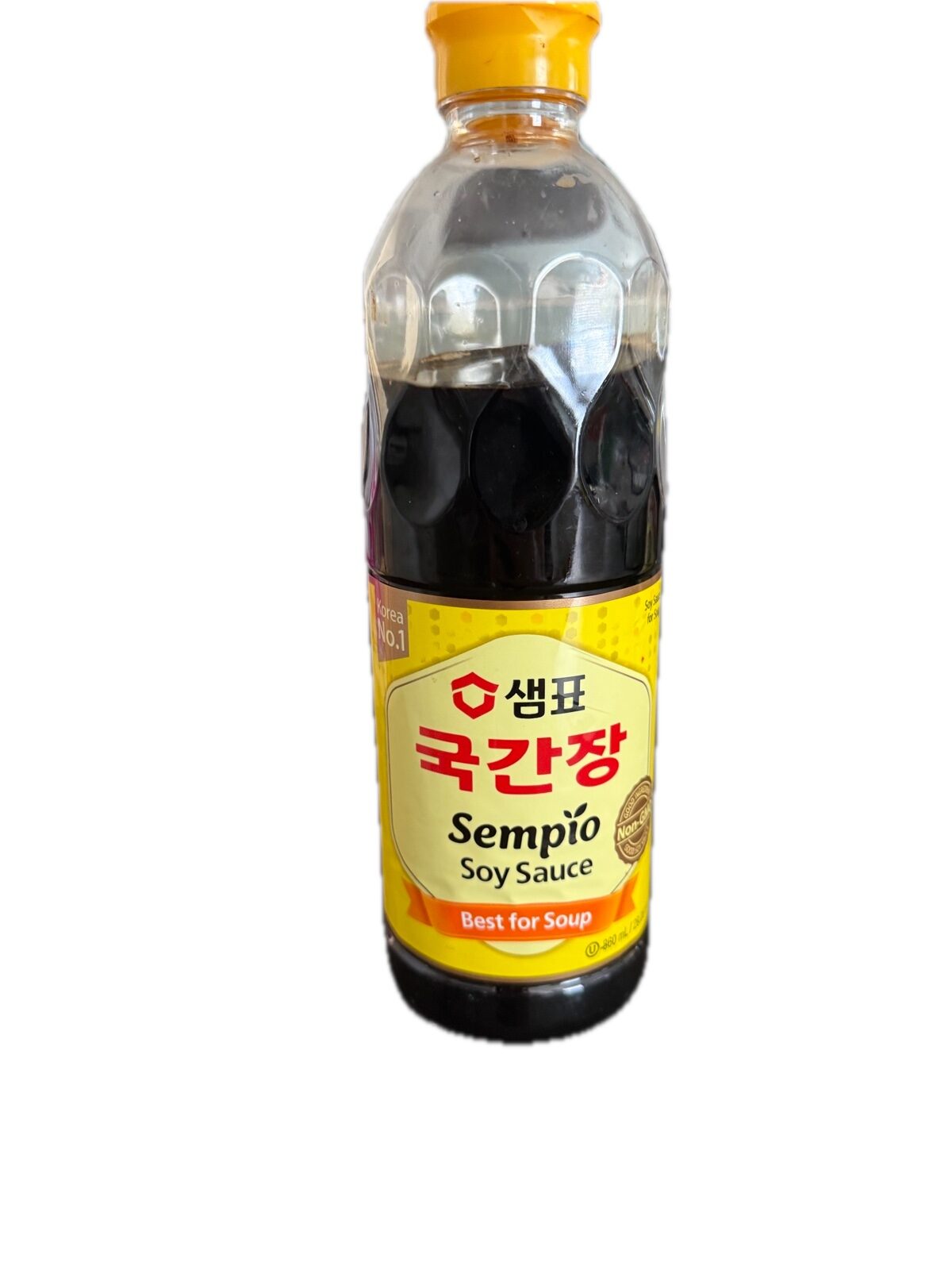
The mistake to avoid: using guk-ganjang in a bulgogi marinade will make it too salty and leave it pale. Using jin-ganjang in a clear soup will turn the broth brown. If you are only buying one bottle to start, buy jin-ganjang — more Korean recipes call for it.
Split Two: How It Was Made
Two bottles can both say Korean soy sauce, cost about the same, and come out of fundamentally different factories. There are two ways to turn soybeans into soy sauce.
Brewing
Soybeans and wheat are cooked, inoculated with koji mold, mixed with brine, and left to ferment for months. Enzymes break the proteins down slowly into amino acids, which is where the savory depth comes from. This is what people mean by soy sauce.
Acid hydrolysis
Defatted soybean meal is broken down with hydrochloric acid, then neutralized with an alkali. It takes days rather than months and costs far less. The result is salty and has some savory character, but it is flat — the layered complexity that comes from slow enzymatic fermentation is simply not there, and color and sweetness are usually added back in.
This is not a fraud, and it is not illegal. Acid-hydrolyzed soy sauce is its own legally defined product category. It is just not the same thing, and it is frequently sold in packaging that does not go out of its way to tell you.
There is also a regulatory reason the two are treated as separate products. Acid hydrolysis produces a processing byproduct that brewing does not, and both Korean and European regulators set legal limits on how much of it a soy sauce may contain. Compliant products stay within those limits, so this is a reason to read the label rather than a reason to worry — and a naturally brewed soy sauce never raises the question at all.
The Blend in the Middle
Most Korean soy sauce sold in the United States is neither one nor the other. It is honhap-ganjang (혼합간장) — brewed soy sauce blended with acid-hydrolyzed soy sauce, in a ratio the label does not have to spell out.
This is the real trap. A bottle can say jin-ganjang (진간장) in large friendly letters on the front and be a blend. Jin-ganjang describes what the sauce is for; it does not tell you how it was made. Those are two separate questions and you have to check both.
You do not have to take our word for it. Sempio, Korea’s largest soy sauce maker, says so itself: its product pages describe jin-ganjang as a deliberate blend that combines the aroma of brewed soy sauce with the concentrated flavor of acid-hydrolyzed soy sauce. That is the manufacturer’s own description of the category, not an accusation from outside it.
The Number on the Bottle: 501 and 701
Here is a detail almost no English-language guide explains, and it is the single most useful thing on a Korean soy sauce label. Sempio’s brewed soy sauces carry a number — 501 or 701 — and it is not a model year or a product line. It is a grade.
| Number | T.N. (total nitrogen) | What it means |
|---|---|---|
| 501 | 1.5% or higher | Standard brewed grade |
| 701 | 1.7% or higher | Sempio’s top brewed grade |
Total nitrogen tracks how much soy protein was broken down into amino acids during fermentation — in other words, how much savory substance is actually dissolved in the bottle. Higher number, more concentrated flavor. It is the closest thing Korean soy sauce has to a published quality figure, and it appears only on brewed products.
A number on the front means it is brewed. No number, and the word jin-ganjang (진간장) instead, usually means it is a blend.
K-Food 4 U
Next: Reading the Label
Knowing the categories is half of it. The other half is finding them on an actual bottle in an actual store, where the useful words are in the smallest print. That is the next guide — plus specific products worth buying in the United States.