Korean soy sauce, in three parts: Part 1 · Where it came from · Part 2 · The kinds · Part 3 · Reading the label
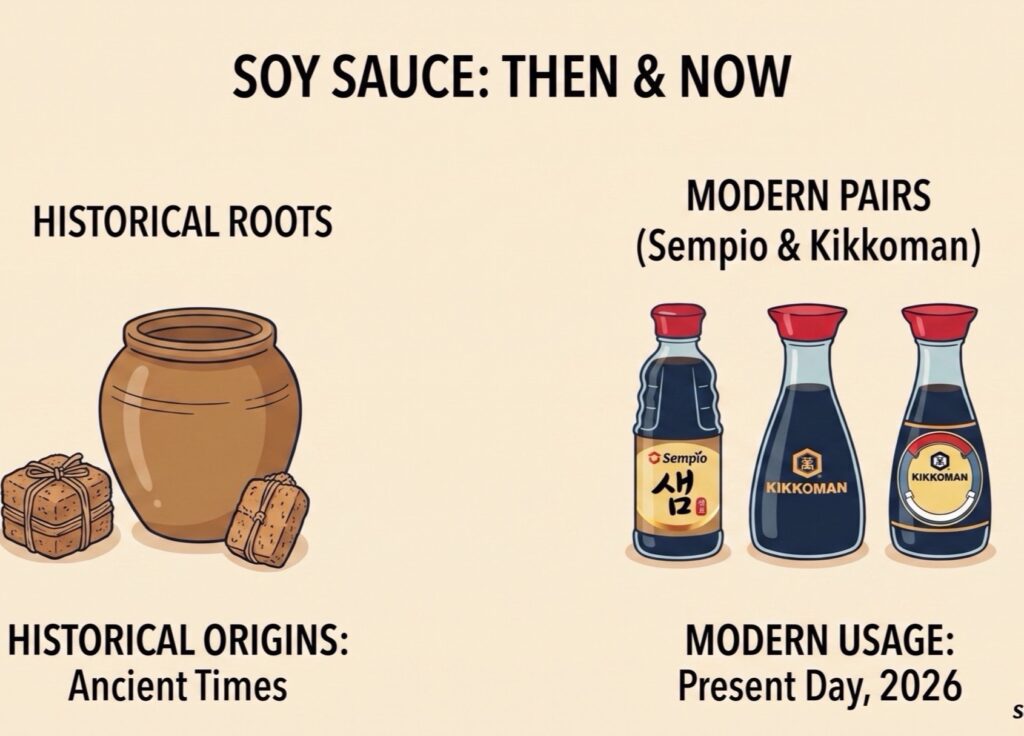
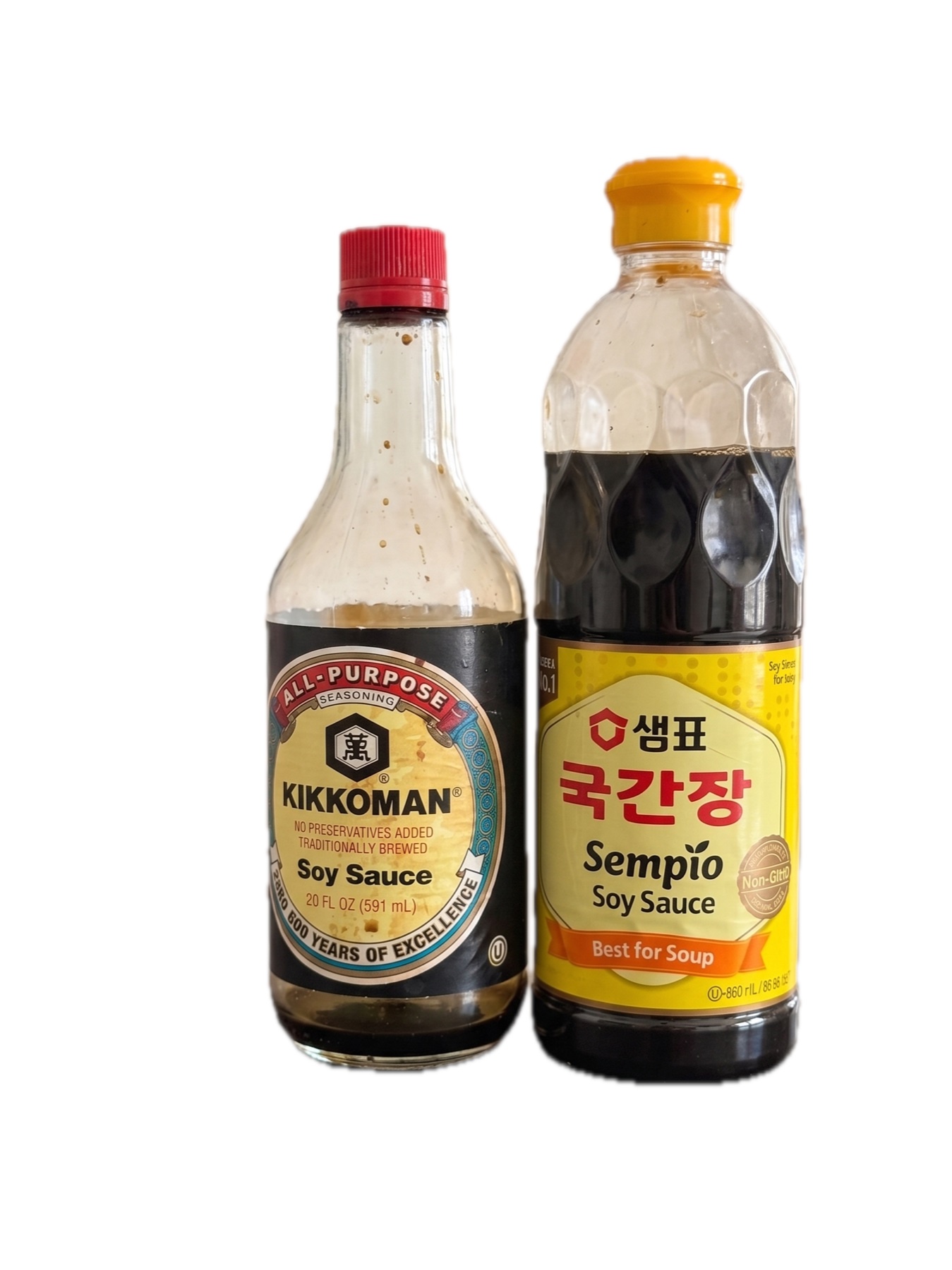
Two bottles on a kitchen counter, both labeled soy sauce. One is Japanese, one is Korean. They descend from the same ancestor, and if you swap them in a recipe you will notice immediately.
This is the first of three guides. Here we cover where soy sauce came from and why the three East Asian traditions ended up so different. Then come the kinds of Korean soy sauce and how to buy it.
It Started in China
The ancestor of all of it is jiang (醬) — Chinese fermented pastes made from grain, beans, and sometimes meat or fish, going back more than two thousand years. The idea was preservation: salt plus time turns perishable protein into something that keeps and tastes of far more than what went in.
The soybean version of that idea spread through East Asia, and each place ended up somewhere different with it. In Korea the same word survives as jang (장), and it still covers the whole family: ganjang (soy sauce), doenjang (soybean paste), and gochujang (chili paste).
How far back it goes in Korea is documented. A third-century Chinese account of the peoples to its east describes the Goguryeo as skilled at fermenting and brewing. The clearest record comes later, in the Samguk Sagi: in 683, when King Sinmun of Silla sent the betrothal gifts for his wedding, the list ran to 135 cartloads of rice, liquor, oil, honey, dried meat, pickled foods — and jang and si, fermented soybean paste and fermented soybeans.
That detail is worth sitting with. Soy sauce was not a commodity condiment. It was valuable enough, and enough of a staple, to be sent by cart to a royal wedding. And since it already appears there as an established food, its actual origin in Korea is older than the record.
Then the Three Countries Diverged
| Korea | Japan | China | |
|---|---|---|---|
| Wheat | Traditional ganjang uses none | Roughly equal parts with soybean | Yes |
| Relationship to bean paste | Made in the same batch | Separate products | Separate products |
| Color | Lighter, clearer | Dark reddish-brown | Light (sheng chou) or dark (lao chou) |
| Flavor | Salty and clean, deeply savory | Sweeter, more aromatic | Varies widely by type |
Korea: one pot, two products
This is the part most people outside Korea have never heard, and it is the reason Korean soy sauce is structurally different from the others.
Traditional Korean jang starts with meju — soybeans that are boiled, crushed, formed into blocks, and hung to dry while wild molds and bacteria colonize them. The meju blocks then go into a crock of brine for months. When it is done, the liquid is drained off: that liquid is ganjang, soy sauce. The solids left behind are mashed and aged further, and those become doenjang.
Korean soy sauce and Korean soybean paste are not two recipes. They are the two halves of one process.
K-Food 4 U
Because there is no wheat in it, traditional Korean soy sauce has none of the sweetness or roasted aroma that wheat brings. It is saltier, lighter in color, and tastes almost purely of fermented soybean. That is a feature, not a shortcoming — it is exactly what you want in a clear soup, where a Japanese soy sauce would muddy both the color and the flavor.
Japan: wheat changes everything
Japanese shoyu uses roughly equal parts soybean and wheat, inoculated with koji mold. The wheat starch ferments into sugars, which is where shoyu’s sweetness, its darker color, and much of its aroma come from. Tamari, the wheat-free type, sits closer to the Korean end of the spectrum.
Most soy sauce sold in American supermarkets is Japanese-style, and most people’s mental image of “soy sauce” is really an image of shoyu.
China: light and dark are different jobs
Chinese cooking splits soy sauce by function. Light soy sauce (sheng chou) is the salty one you season with. Dark soy sauce (lao chou) is aged longer, often with molasses or caramel added, and is used for color more than for salt. If you have a bottle of Chinese dark soy sauce and use it like Korean ganjang, your dish will come out nearly black.
In Korea, Jang Was Never Just an Ingredient
Understanding Korean soy sauce means understanding that for most of Korean history it was not something you bought. It was something your household made, once a year, and the result determined how everything you cooked tasted for the next twelve months.
The jangdokdae
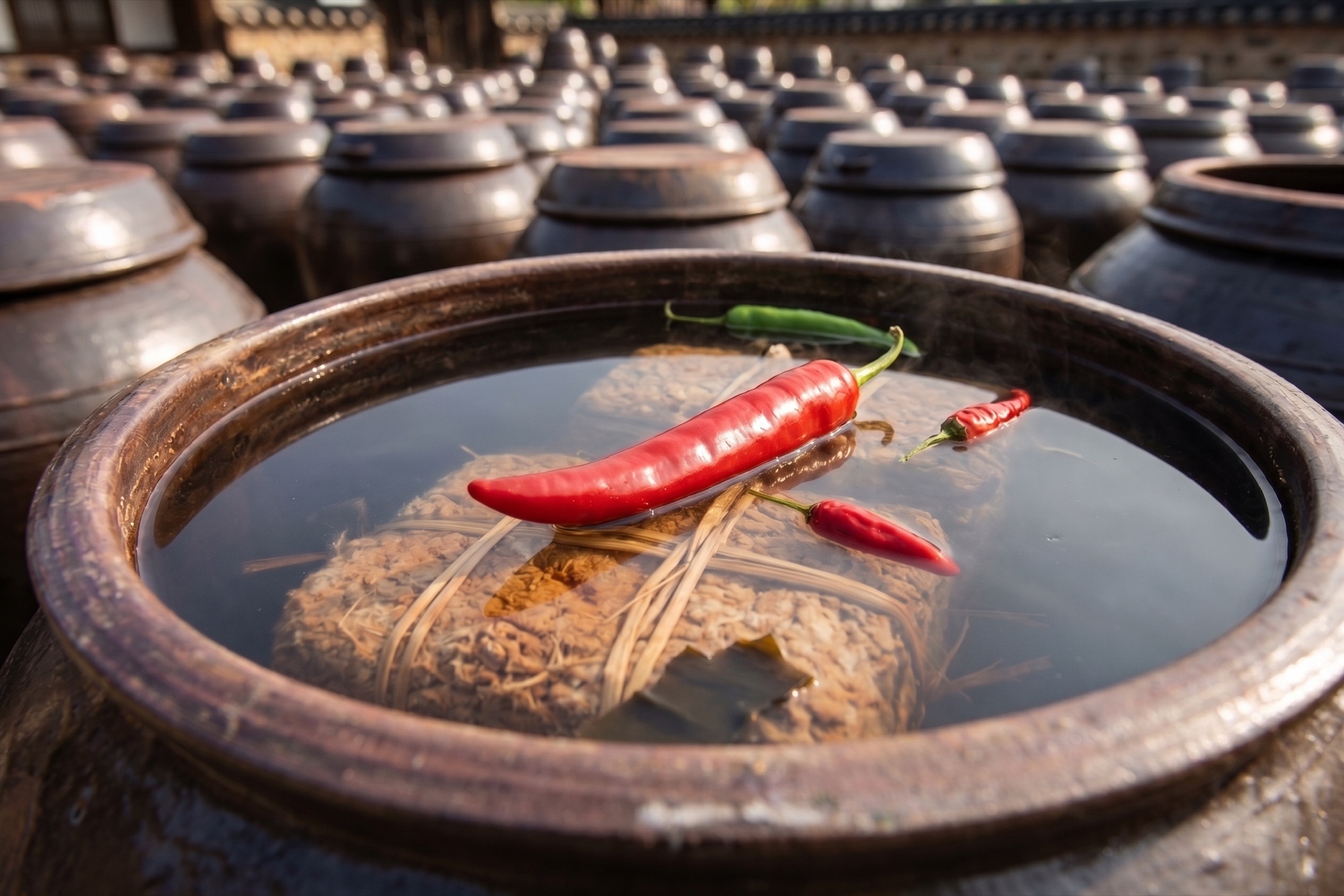
Every traditional Korean home had a jangdokdae (장독대) — a raised platform of earthenware crocks, placed in the sunniest spot available, usually facing south. It was the pantry, the larder, and the engine room of the household kitchen all at once, and it was run by the woman of the house.
The crocks themselves matter. Onggi (옹기) are fired so that the clay walls stay microscopically porous — air moves through them, liquid does not. A breathing container, in other words, which is exactly what a months-long fermentation needs. Glass and plastic seal; onggi exchanges.
Jang-making day
Jang was made at a fixed point in the calendar, in late winter, when the cold kept unwanted microbes down while the meju did its work. The day itself was chosen carefully — households consulted the lunar calendar for an auspicious date and avoided inauspicious ones.
Around the finished crock went a geumjul, a straw rope hung with red chilies and lumps of charcoal, and pasted onto the jar was a paper cutout in the shape of a beoseon, a Korean sock, turned upside down. The stated purpose was to keep out bad spirits. The practical effect was that everyone in the household understood the crock was not to be disturbed.
Ssi-ganjang: the chain that does not break
This is the practice that has no real equivalent elsewhere. When a household drew off its soy sauce, it did not empty the crock. A portion was held back as ssi-ganjang (씨간장) — seed soy sauce — and the following year’s new batch was poured in on top of it.
Repeat that for a few decades and the crock holds a continuous line. Repeat it across generations, as the head families of some Korean clans have, and the soy sauce in the jar is older than anyone alive who has tasted it. Some family seed jang is said to run back centuries. Nothing in the crock is original; the chain is.
A house where there is too much arguing has bitter jang.
Korean proverb
The proverb is about attention, not superstition. Jang needs the crock opened on clear days and closed before rain, the surface skimmed, the sun let in. A household too busy quarrelling to tend it would taste the neglect at every meal for a year — which is also why a family’s jang was treated as a fair measure of the household itself.
Recognized in 2024
In December 2024, UNESCO added jang-making in the Republic of Korea — the knowledge, beliefs and practices around making and sharing jang — to its Representative List of the Intangible Cultural Heritage of Humanity. Not a recipe: the culture around it.
Almost nobody makes their own jang at home in Korea today. But this is the tradition the bottle on the supermarket shelf is descended from, and it is why the difference between a slow-fermented soy sauce and a chemically hydrolyzed one is felt as a bigger deal in Korea than the price gap alone would explain.
Next: What to Actually Buy
Knowing the history explains why Korean soy sauce comes in more than one kind and why two bottles that look identical can be made completely differently. That is the next guide — guk-ganjang versus jin-ganjang, and brewed versus blended.