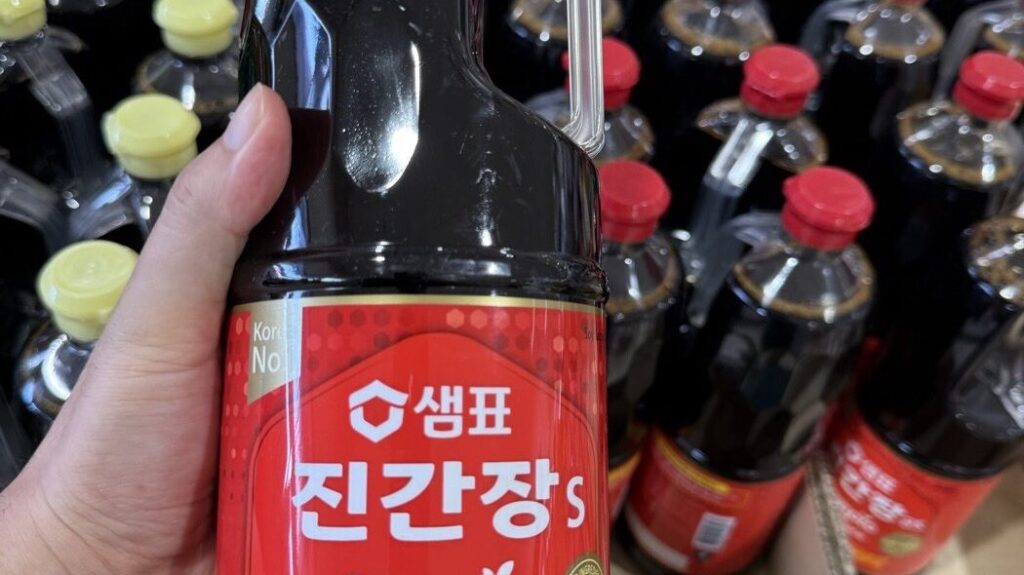
Korean soy sauce bottles do not make this easy. The front of every one of them is confident — premium, 100%, Korea No.1 — and the thing that actually separates a good bottle from a mediocre one is printed on the back in the smallest type on the label.
It is also simpler than it looks. Count the ingredients.
The short answer
If you are standing in the aisle now:
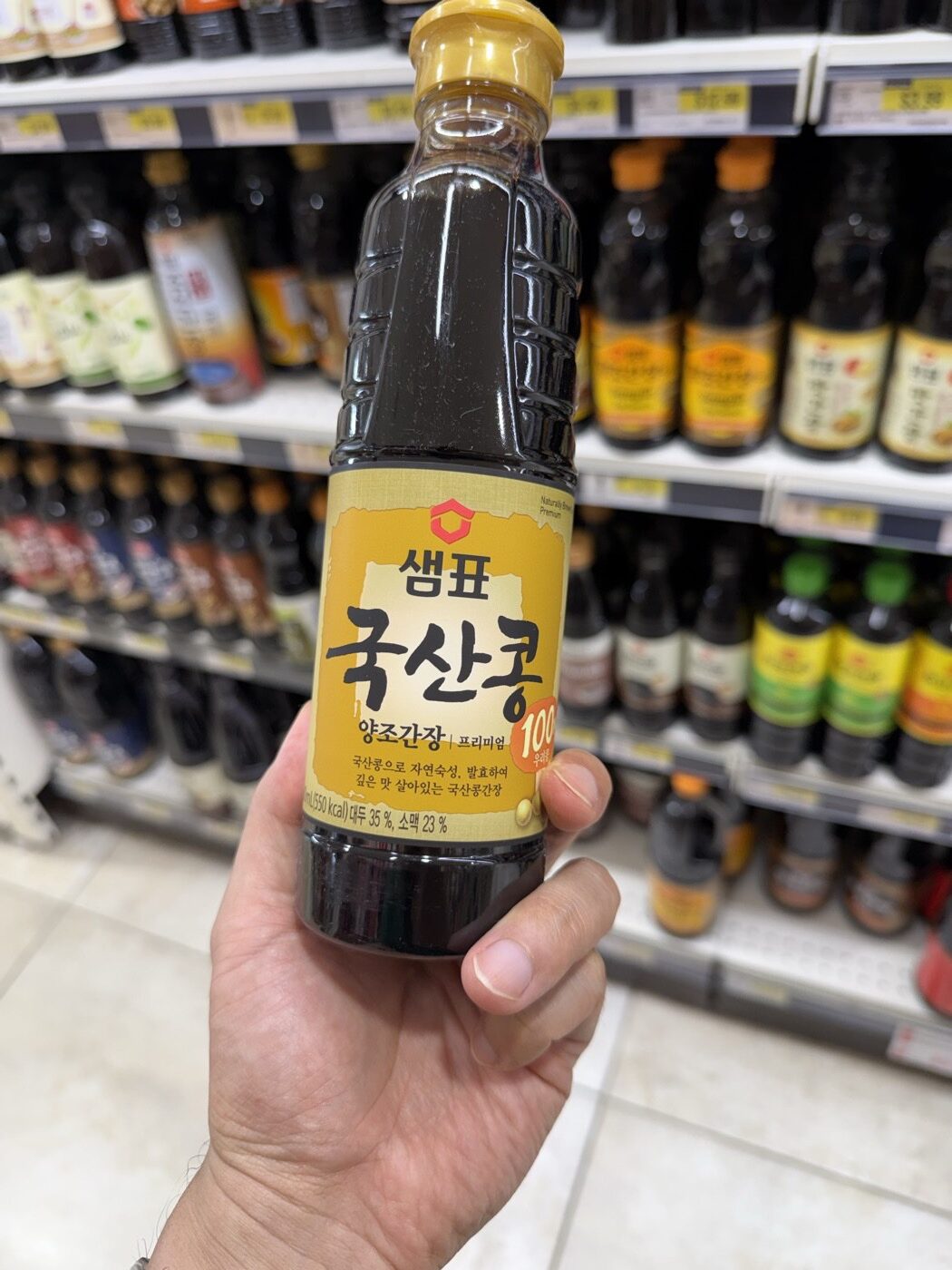
- Buy Sempio Naturally Brewed Soy Sauce, Korean Soybean (국산콩 양조간장) if your store has it. Five ingredients: water, soybean, wheat, salt, spirits. Note that it says soybean, not defatted soybean.
- Sempio Naturally Brewed 701 (양조간장 701) is the everyday bottle and was $4.99 for 500 mL. Eight ingredients, no preservative, no MSG.
- Put back anything that lists fructose, MSG or a preservative — no matter what the front of the bottle claims.
The rest of this explains why, using four bottles photographed on one trip.
Five ingredients
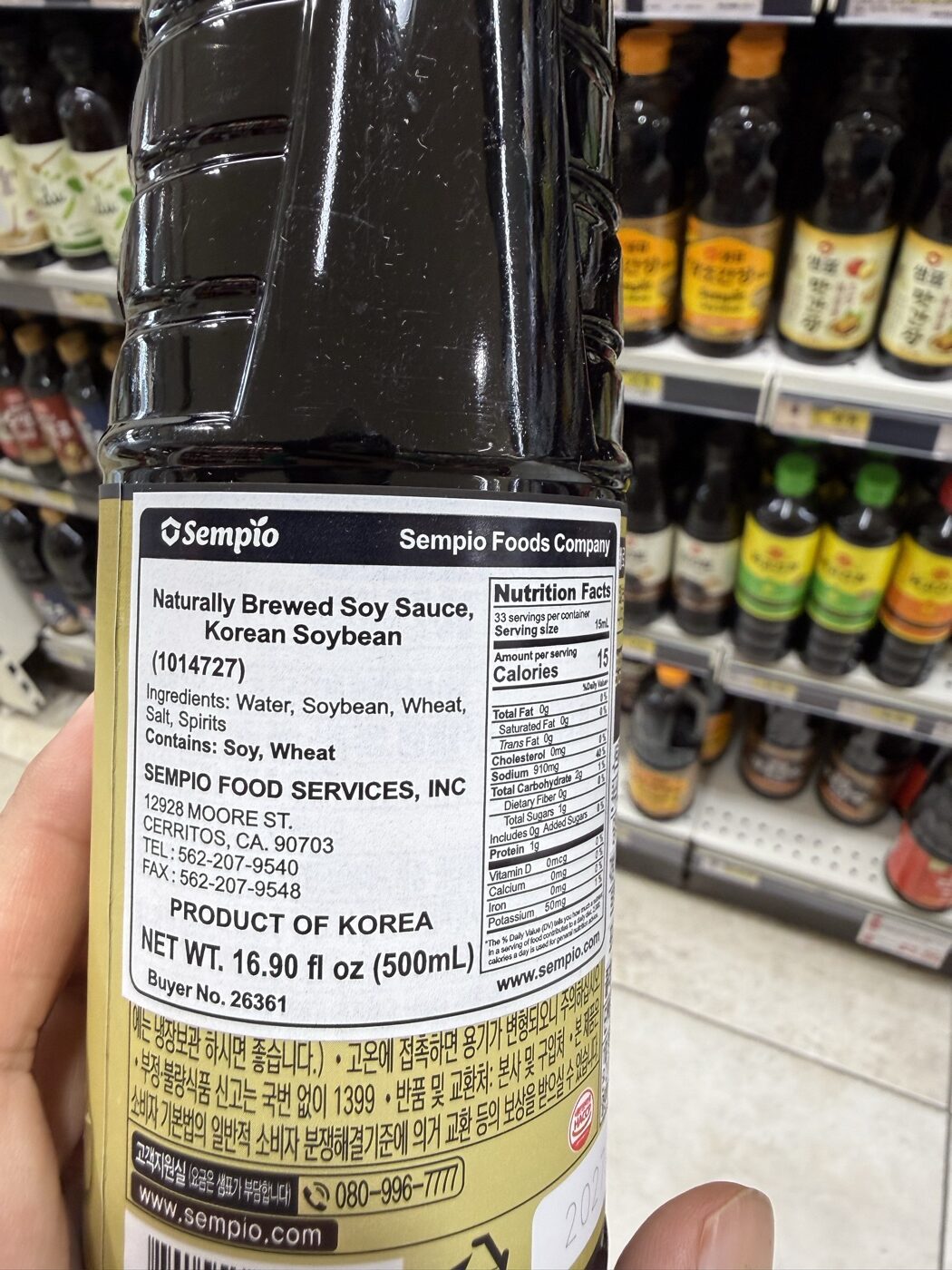
This is the back of Sempio’s Korean-soybean bottle, and it is the shortest list you are likely to find on a supermarket shelf:
Water, Soybean, Wheat, Salt, Spirits.
That is what brewed soy sauce needs. The spirits are a normal preservative in fermented soy sauce and nothing to avoid. What is not there matters more: no sweetener, no colour, no flavour enhancer. Six months in brine did that work.
The word soybean rather than defatted soybean is the other thing to notice. Defatted soybean is the meal left after the oil has been pressed out — cheaper, and perfectly normal in good soy sauce. Whole soybean is a step up, and bottles that use it say so.
Eight ingredients
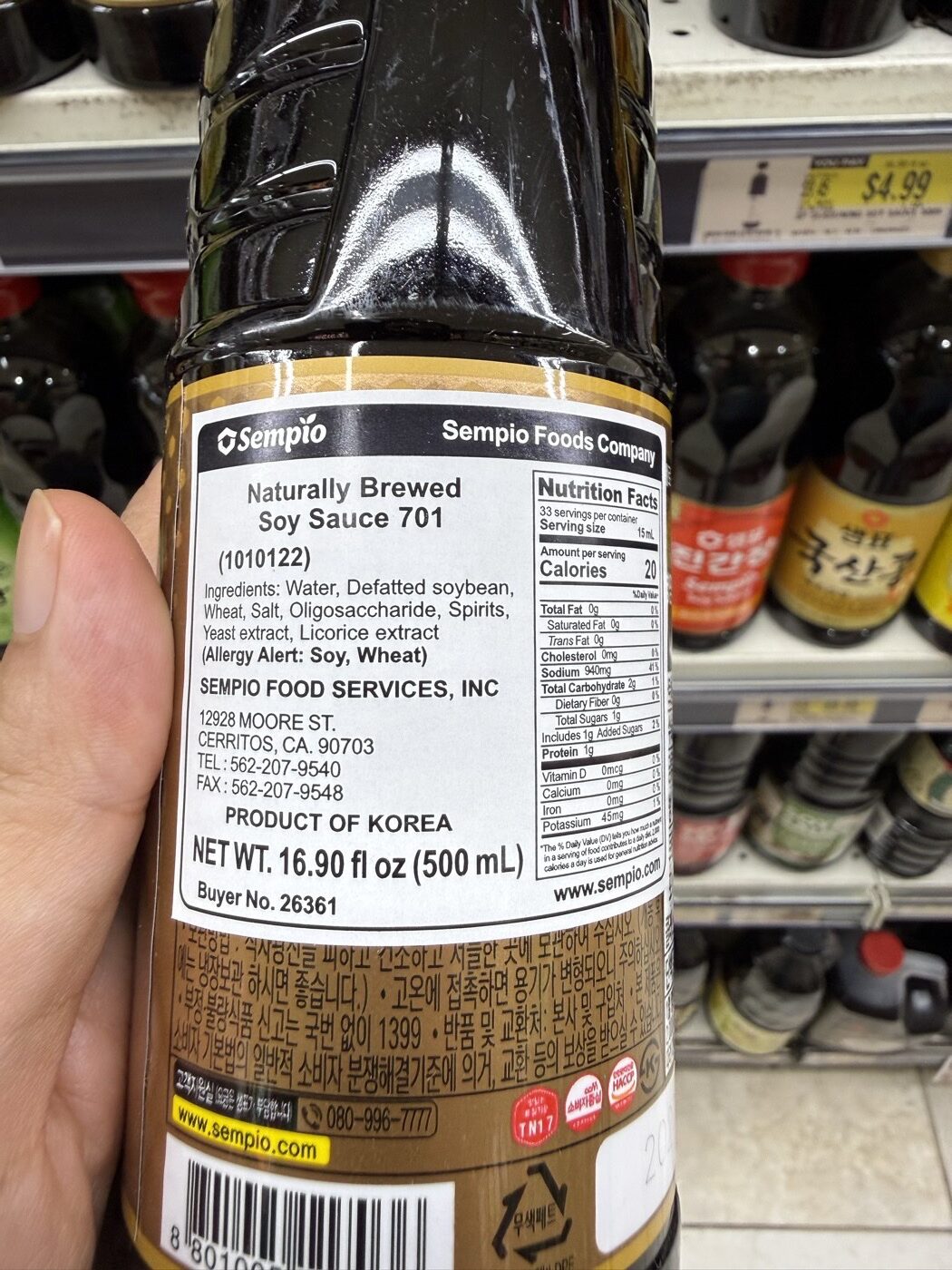
Sempio’s 701 is the workhorse: water, defatted soybean, wheat, salt, oligosaccharide, spirits, yeast extract, licorice root extract. Eight items, a sweetener among them, and no preservative. The front says Naturally Brewed.
This is the bottle to buy if you cook Korean food regularly and do not want to think about it. Four dollars ninety-nine for 500 mL.
Nine ingredients, and a preservative
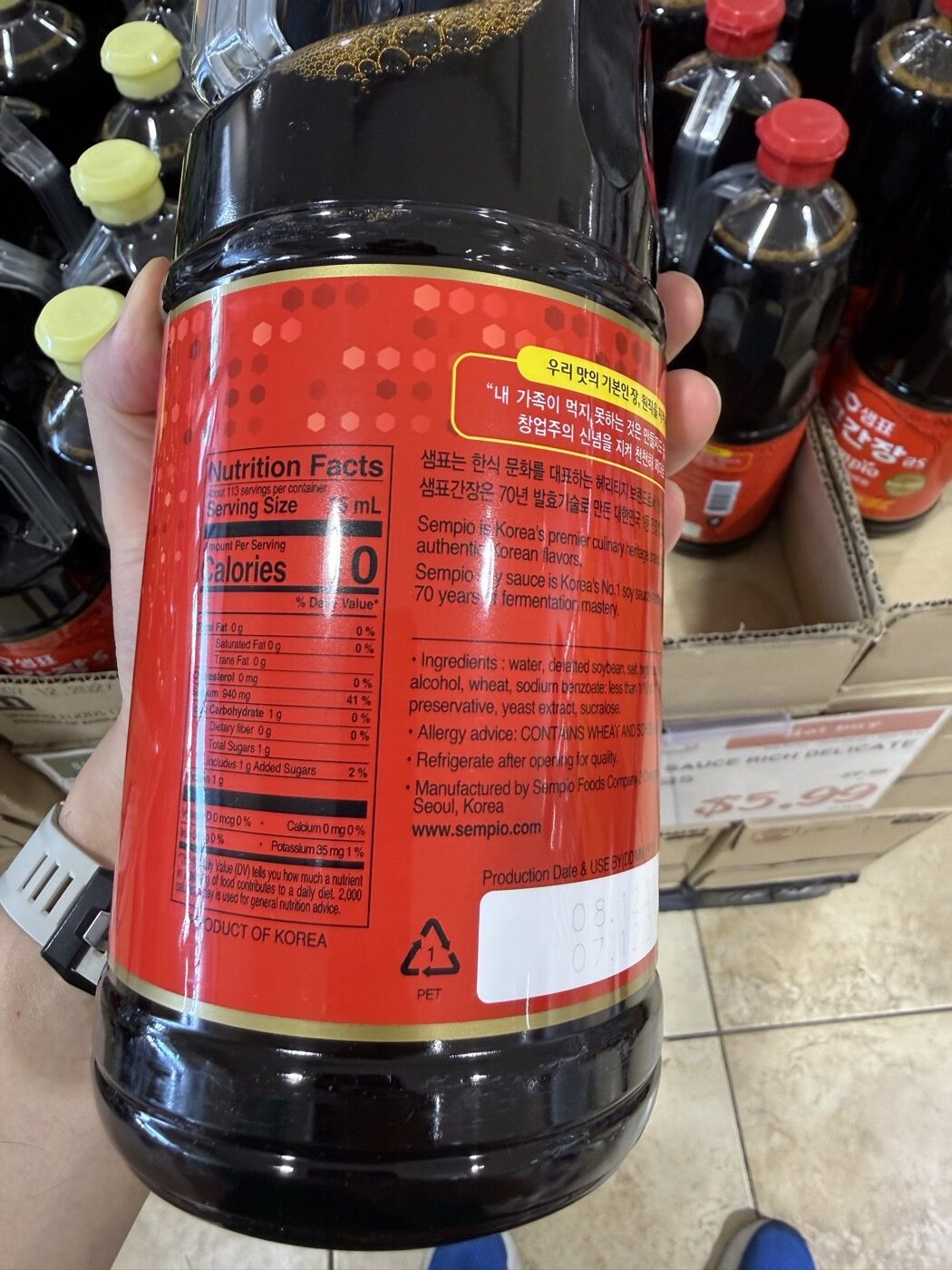
Sempio’s jin-ganjang S is the red bottle, the one most households actually reach for. Water and defatted soybean at the top, then salt, alcohol and wheat — and further down, sodium benzoate as a preservative and sucralose as a sweetener.
Here is the part that catches people out: this bottle has fewer calories than the 701 — zero per serving against twenty — because sucralose contributes none. Read the nutrition panel alone and the cheaper bottle looks like the better choice.
The nutrition panel is the wrong place to look.
Twelve ingredients, and the front tells the truth anyway
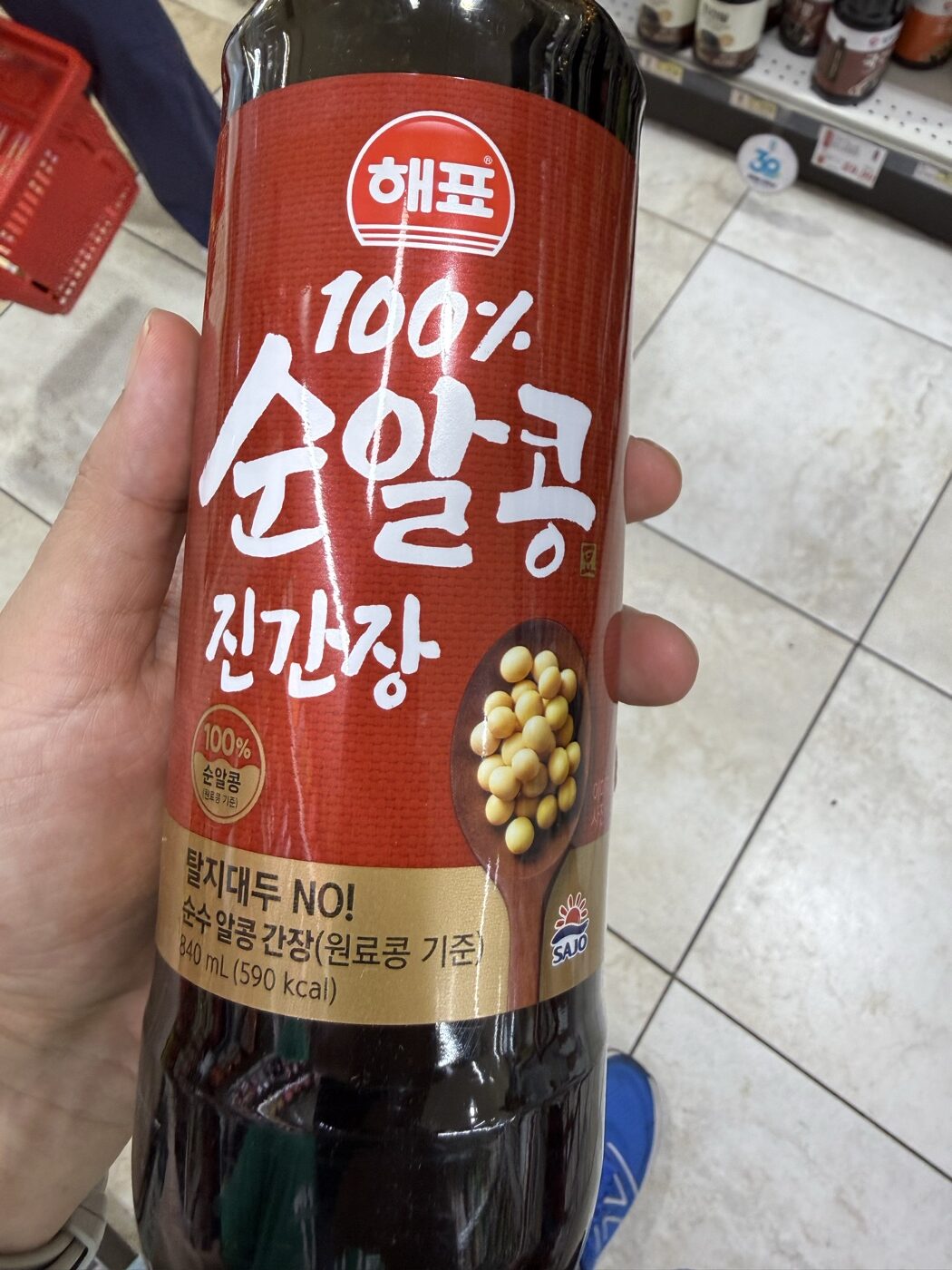
This bottle is the reason none of this can be settled from the front label. Haepyo’s 순알콩 진간장 says 100% whole soybean and, underneath, 탈지대두 NO! — no defatted soybean. Both claims appear to be true, and both are genuinely better than the alternative.
Now the back:
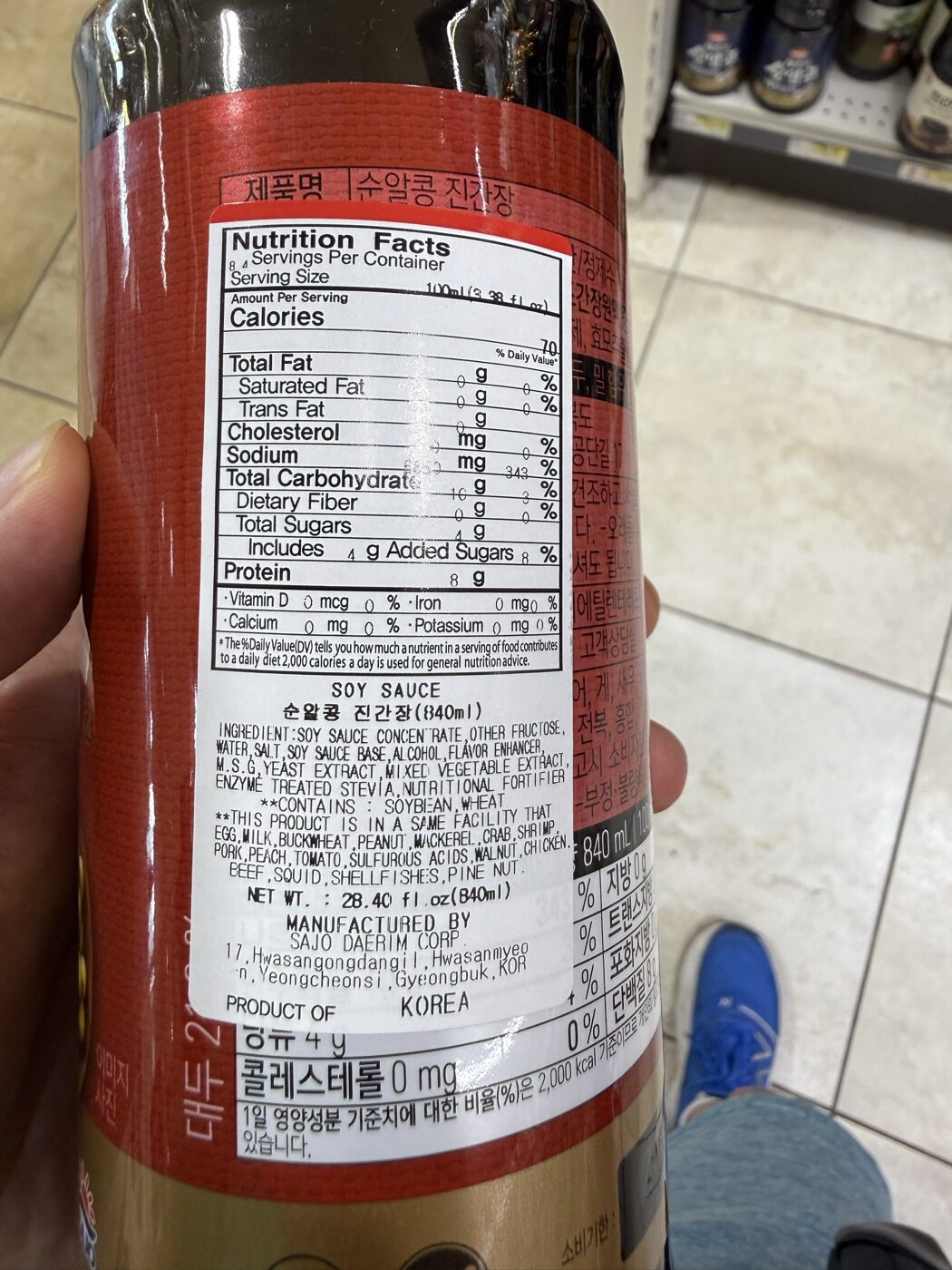
Soy sauce concentrate, other fructose, water, salt, soy sauce base, alcohol, flavour enhancer, M.S.G., yeast extract, mixed vegetable extract, enzyme treated stevia, nutritional fortifier.
Fructose is the second ingredient, ahead of water. There are two sweeteners, a flavour enhancer and MSG. Four grams of added sugar per 100 mL, against one gram in the Sempio bottles.
The front was not lying. It was answering a different question. A soy sauce can be made from excellent whole soybeans and still be a formulated product.
What the sweetener is actually telling you
Korean soy sauce is made three ways, and this is the distinction the ingredient list exposes:
- Brewed (양조간장) — fermented in brine, typically six months or more.
- Acid-hydrolysed (산분해간장) — soy protein broken down with hydrochloric acid at high heat. Hours instead of months.
- Blended (혼합간장) — the two mixed. Most cheap soy sauce is this.
Acid hydrolysis tastes like what it is: harsh, flatly salty, with an off smell. So it gets corrected afterwards. Sweeteners blunt the salt, caramel colour replaces the colour fermentation would have built, activated carbon strips the smell.
None of those additives is dangerous at the dose in a spoonful of soy sauce. The point is not that the sweetener will hurt you. It is that it is there because something needed covering. A sauce that fermented for six months does not need its salt blunted.
And the category name will not save you either. Korea’s food code sets no ratio for what may be called 혼합간장 — a bottle that is 99% acid-hydrolysed and 1% brewed carries the same name as one that is mostly brewed. A 2018 investigation found products built on 93% chemically produced soy sauce still sold under that label.
The one health point worth making
Acid hydrolysis creates a contaminant called 3-MCPD. It is not added; it forms when hydrochloric acid meets the fat left in soy protein. The International Agency for Research on Cancer classifies it as possibly carcinogenic to humans (Group 2B), the European Food Safety Authority sets a tolerable daily intake of 2 micrograms per kilogram of body weight, and soy sauce carries a maximum permitted level of 20 micrograms per kilogram.
Regulated and monitored, in other words. This is not a reason to throw out the bottle in your fridge. It is a reason to pick the brewed one when both are on the shelf and the gap is a dollar: properly brewed soy sauce is essentially free of it, because the process that creates it never happens.
But is the sugar a problem?
Almost certainly not, and it is worth saying plainly because it is the first thing people worry about when they see fructose on a label. A tablespoon of soy sauce carries about a gram of sugar. Fructose, contrary to the usual assumption, has a lower glycaemic index than glucose — 23 against 100. Its real drawbacks concern habitual excess and how the liver handles it, not a spoonful in a marinade.
Worry about the sodium instead. That tablespoon carries roughly 40% of a day’s recommended sodium, and that is as true of the five-ingredient bottle as of the twelve-ingredient one.
So: what to buy
- Everyday cooking. Sempio Naturally Brewed 701, or the Korean-soybean bottle if you can find it. Both say Naturally Brewed on the front and back it up on the back.
- One step up. The Korean-soybean bottle, at five ingredients, is the cleanest list on an ordinary shelf and costs a few dollars more.
- Buy a second bottle of guk-ganjang (국간장) when you start making soups. It is a different product, not a lesser one, and nothing else does its job.
- Skip anything whose back lists fructose, MSG, a flavour enhancer or a preservative — however good the front looks.
One habit covers all of it: turn the bottle around before it goes in the cart, and count. Five is excellent. Eight is fine. Twelve is a different kind of product.
Our guide to reading the label covers the rest of the bottle, and the guide to the kinds explains where guk-ganjang fits.